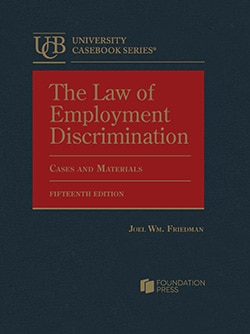
Friedman's The Law of Employment Discrimination, Cases and Materials, 15th
Access to digital products is available immediately after completing your purchase. Please visit eproducts.westacademic.com and sign in.
Description
This casebook covers all major aspects of employment discrimination law, including benchmark legislative, administrative, and judicial developments. Due in part to frequent updates and revisions, it has received accolades as one of the most comprehensive and frequently updated texts on the market. The 15th Edition continues this tradition by seamlessly incorporating all major legislative and judicial developments through March 2026, including all relevant decisions rendered by the Supreme Court in its 2024-2025 term, with no major cases pending for the 2025-2026 term. There were two major Supreme Court rulings in the 2024-2025 term. One was in Ames v. Ohio Department of Youth Services, where a unanimous Court issued its latest ruling in an affirmative action/reverse discrimination case. The Court soundly rejected the defendant’s contention that a majority-group individual plaintiff in a reverse discrimination case should shoulder a heightened evidentiary burden to establish a prima facie case of intentional discrimination by showing background circumstances to support the suspicion that the defendant is that unusual employer who discriminates against the majority. Instead, the Court reiterated its adherence to the traditional McDonnell Douglas proof standard. The other was Stanley v. City of Sanford, where a seven member majority resolved the conflict as to whether a retired former employee who did not hold or seek a job when suit was filed was a “qualified individual” to bring suit under the ADA for an alleged act of discrimination that occurred during its term of employment. Focusing on the present tense of this statutory provision, the majority ruled that a retired former employee only has standing to challenge an employer action if the plaintiff held or desired to hold a job and could perform its essential functions at the time of the alleged act of discrimination.
There also were important circuit court opinions. In Henry v. Southern Ohio Med. Center, the Sixth Circuit ruled that an accommodation request for exemption from a hospital’s mandated COVID testing policy imposed an undue hardship on the employer. The Fourth Circuit, in Thomas v. EOTECH, LLC, held that a private sector employer cannot shorten the time limits set by Congress in Title VII and the ADEA for filing an EEOC charge or civil suit by requiring its employees to sign an agreement limiting the filing of EEOC charges or civil actions to a shorter time period and thereby agreeing to waive any charge or suit filed beyond that limit. In another procedural ruling, the Ninth Circuit in Asuncion v. Hegseth held that the ninety day time limit for filing a Title VII action upon receipt of the right to sue letter starts to run from the time that the letter is transmitted electronically. And in Stanley v. City of Sanford, an ADA case, the Eleventh Circuit held that a retired individual could only assert an ADA claim if that person was a qualified individual at the time of the alleged act of discrimination or when it became subject to that alleged discriminatory act or felt its effects. Finally, in 2021, Congress enacted the Ending Forced Arbitration of Sexual Assault and Sexual Harassment Act (EFAA) which rendered unenforceable arbitration agreements in cases “relating to” a claim of sexual harassment, thereby allowing a grievant to file suit. And in a case of first impression, the Sixth Circuity, in Bruce v. Adams and Reese, ruled that when a plaintiff alleged both a claim of sexual harassment and a non-sexual harassment related claim, the EEFA rendered the arbitration agreement unenforceable as to both claims.
There also were important circuit court opinions. In Henry v. Southern Ohio Med. Center, the Sixth Circuit ruled that an accommodation request for exemption from a hospital’s mandated COVID testing policy imposed an undue hardship on the employer. The Fourth Circuit, in Thomas v. EOTECH, LLC, held that a private sector employer cannot shorten the time limits set by Congress in Title VII and the ADEA for filing an EEOC charge or civil suit by requiring its employees to sign an agreement limiting the filing of EEOC charges or civil actions to a shorter time period and thereby agreeing to waive any charge or suit filed beyond that limit. In another procedural ruling, the Ninth Circuit in Asuncion v. Hegseth held that the ninety day time limit for filing a Title VII action upon receipt of the right to sue letter starts to run from the time that the letter is transmitted electronically. And in Stanley v. City of Sanford, an ADA case, the Eleventh Circuit held that a retired individual could only assert an ADA claim if that person was a qualified individual at the time of the alleged act of discrimination or when it became subject to that alleged discriminatory act or felt its effects. Finally, in 2021, Congress enacted the Ending Forced Arbitration of Sexual Assault and Sexual Harassment Act (EFAA) which rendered unenforceable arbitration agreements in cases “relating to” a claim of sexual harassment, thereby allowing a grievant to file suit. And in a case of first impression, the Sixth Circuity, in Bruce v. Adams and Reese, ruled that when a plaintiff alleged both a claim of sexual harassment and a non-sexual harassment related claim, the EEFA rendered the arbitration agreement unenforceable as to both claims.